
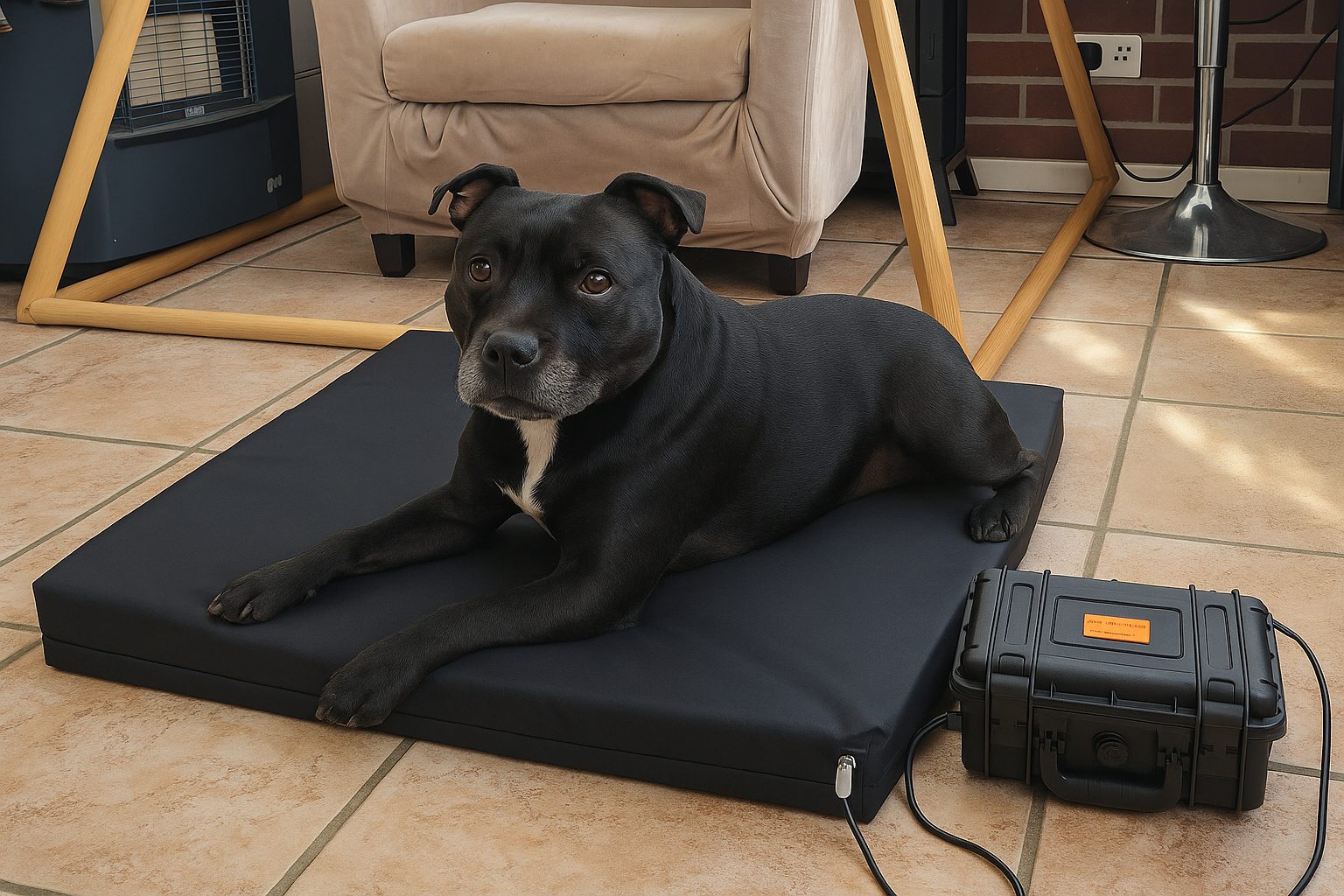
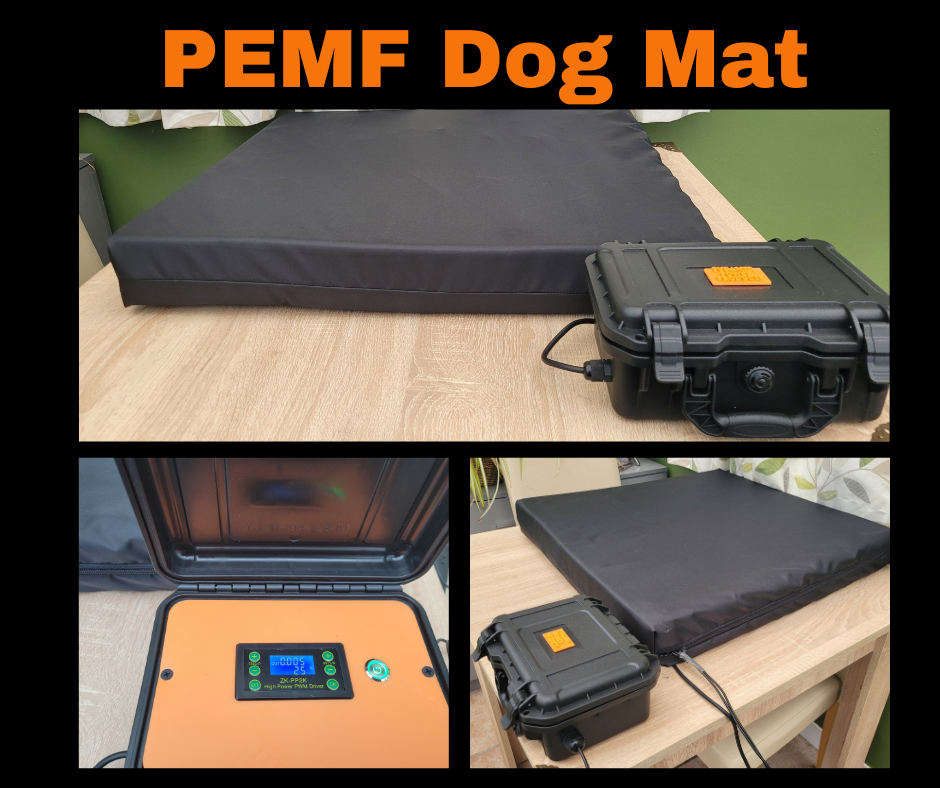
Want a simple, non-invasive way to help your dog relax, recover after activity, and move more comfortably—without adding another pill to the bowl? A Dog PEMF Mat (pulsed electromagnetic field mat) turns nap time into useful time. Your dog lies down on a comfy pad while gentle, low-frequency magnetic pulses pass through fur and skin to the tissues beneath. No noise, no heat, no tingling—just quiet, repeatable sessions that fit into real life.
This long-form sales page is built to rank for “DOG PEMF MAT” and built to convert: clear benefits, usage tips, safety notes, and direct links to independent science and real-owner anecdotes so you can buy with confidence.

Why a Dog PEMF Mat?
- Passive & pet-friendly. Dogs don’t have to “do” anything. They simply settle on a familiar spot and let the session run.
- Whole-body calm. Great for multi-joint stiffness and “restless after a big day” dogs.
- Consistency made easy. Because sessions feel like a nap, daily use becomes effortless—and consistency is where results live.
Clinical and veterinary sources increasingly discuss PEMF as a low-risk adjunct inside a broader, sensible plan for canine comfort and mobility. It’s not magic and not a cure—but for many households it becomes a reliable daily ritual that dogs learn to love. (PubMed)
How it works (plain English)
Your dog’s cells and nerves constantly talk using tiny electrical signals. Age, stress, or strain can nudge those signals off balance. A PEMF mat sends gentle magnetic pulses through the body, which in turn induce small electrical fields in tissues—nudging signaling, blood flow, and cellular energy in a helpful direction. Veterinary reviews summarize growing use across osteoarthritis, wound care, and post-operative comfort. (PubMed)
What you can (realistically) expect
We’re pro-science and pro-transparency. Here’s what controlled studies and real-owner experience suggest—plus where expectations should stay grounded.
1) Everyday comfort & mobility support
A randomized, double-blind, placebo-controlled study in 60 pet dogs with osteoarthritis found that two weeks of daily PEMF improved owner-reported quality-of-life behaviours and increased passive range of motion (PROM) compared with sham. That’s real-world movement, not just lab numbers. (PMC)
2) Post-surgery comfort & wound recovery support
After spinal surgery (hemilaminectomy), dogs that received targeted PEMF had better incisional wound scores at six weeks and owners gave fewer pain meds in the first week than controls. That’s a practical comfort signal families can notice. (PubMed, Meridian)
In a separate neurosurgical trial, PEMF was associated with less incision pain and favourable neurologic biomarker changes during early recovery. (petvetbiomed.com)
3) Behavioural calm (emerging evidence)
A randomized, placebo-controlled study explored a head-applied PEMF device for canine separation anxiety and reported meaningful symptom improvements for many dogs. It won’t replace training or enrichment, but it’s a promising adjunct for “worrier” pups. (PMC)
4) “One-and-done”? Probably not.
A 2024 cross-over study testing a single PEMF session in dogs with hip osteoarthritis did not detect immediate changes in owner-reported pain or gait—useful proof that consistency beats quick fixes. Aim for daily sessions for 2–4+ weeks. (PMC)
5) Big-picture veterinary context
Independent veterinary overviews place PEMF among non-drug adjuncts for canine osteoarthritis and recovery—helpful, low-risk, and worth trying as part of a multimodal plan (weight, movement, home set-up, meds when needed), while acknowledging the evidence base is still maturing. (DVM 360)
Who it’s perfect for
- Senior snugglers easing into gentler days
- Weekend warriors (or zoomie fans) who go hard then crash
- Arthritis-prone breeds (Labs, Goldens, Shepherds, Danes)
- Post-op patients (under your vet’s plan)
- Velcro-dogs & worriers who benefit from predictable calm
Owners often report easier mornings, smoother stairs, and quicker settling after activity—exactly the kind of daily wins you want.
How to use a Dog PEMF Mat (step-by-step)
1) Place it where your dog already chooses to rest.
Bed, sofa end, under the office desk—familiar is best.
2) Start small.
Run 10–15 minutes once daily for a week. Watch comfort cues.
3) Build consistency.
Increase to 20–30 minutes, 4–7 days per week. The osteoarthritis RCT above used daily sessions across 14 days—a good benchmark. (PMC)
4) Stack the basics.
Pair PEMF with joint-friendly flooring/runners, ramps, trimmed nails, low-impact walks, and a healthy body condition score. (These changes matter as much as any device.) (DVM 360)
5) Post-surgery?
Follow your veterinarian’s timing and positioning guidance. The spinal-surgery studies applied PEMF during the post-operative period with encouraging comfort and wound-score signals. (PubMed, petvetbiomed.com)
Safety & sensible use
PEMF used in veterinary contexts is generally well-tolerated with few reported adverse effects. Still:
- Avoid use in pets (or nearby humans) with implanted electronic devices unless the device specialist and your vet explicitly approve.
- Use caution around pregnancy, active infections, or open wounds unless your vet instructs otherwise.
- If your dog seems unsettled, shorten sessions and re-introduce gradually.
- Remember: PEMF is a wellness adjunct, not a substitute for veterinary diagnosis or prescribed treatment. (PubMed)
Why choose our Dog PEMF Mat
Dog-first comfort. Sizes for curlers and sprawlers, a wipe-clean cover, quiet electronics, and no distracting vibrations.
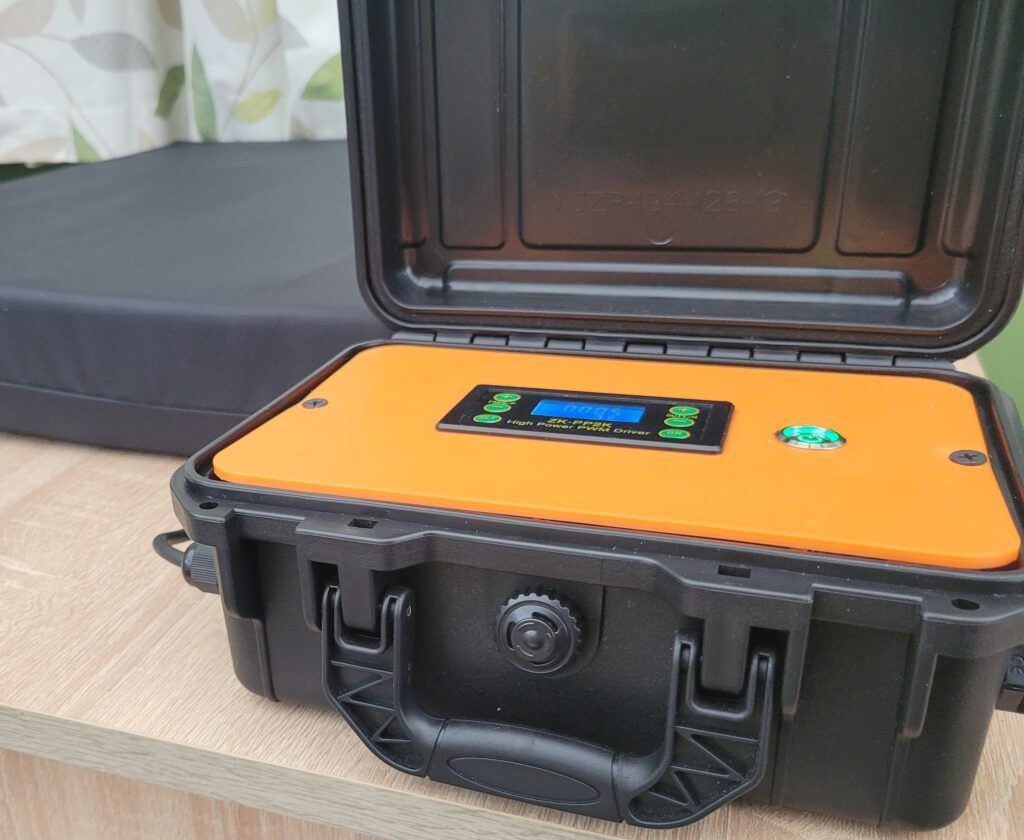
Set-and-relax programs. 10/20/30-minute presets with soft start/stop—easy for any family member to use.
Transparent tech. Clear frequency ranges (Hz) and magnetic flux density (mT/gauss). No “mystery modes.”
Independently tested. Electrical safety and EMC checks for home peace of mind.
Friendly guarantee. Try it for 30 days. If your dog doesn’t lean into it, you can lean on us.
Compare: Mat vs. Loop vs. Wand
- Mat: effortless, whole-body calm and consistency (great daily baseline).
- Loop/Wand: excellent for spotlighting a specific elbow, hip, or surgical site.
Many homes use both—mat for routine, loop for local flare-ups. (Veterinary papers cover both targeted and non-targeted approaches.) (PubMed)
Real-owner voices (anecdotal—but useful)
Anecdotes aren’t clinical trials, yet they show lived experience: dogs choosing the mat for naps, smoother stairs after a few weeks, calmer evenings. We’ve linked examples from owner forums and vet blogs below so you can browse unfiltered stories alongside the science.
Frequently asked questions
Is this a medical device?
Consumer dog PEMF mats are wellness products. They’re not intended to diagnose, treat, cure, or prevent disease. Work with your veterinarian for medical conditions. (Clinical research is active and encouraging across several areas.) (DVM 360)
How quickly will I notice a difference?
Some dogs look visibly soothed in the first session. For mobility-related changes, give it 2–4+ weeks of daily use—that’s the cadence reflected in osteoarthritis trials. (PMC)
Can I use it after surgery?
Often yes—if your vet approves and sets the schedule. In spinal-surgery studies, PEMF was linked to better wound scores and less pain medication use during recovery. (PubMed)
Any side effects?
PEMF is generally well-tolerated. If your dog seems restless, stop the session, give a break, and reintroduce at a lower duration/intensity. (PubMed)
Will one long session beat multiple short ones?
Not necessarily. Short, consistent sessions tend to work better than occasional marathons—and a notable study showed no immediate change after just a single treatment. (PMC)
The take-home
- A Dog PEMF Mat helps you build a predictable relax-and-recover ritual at home.
- Evidence in dogs points to comfort and functional signals with routine use, plus post-op comfort benefits, while acknowledging not every endpoint changes and consistency matters. (PMC, PubMed)
- It’s low-effort for you, low-stress for your dog, and pairs perfectly with the fundamentals your vet already recommends.
Ready to make rest count?
Give your dog a calmer, comfier routine. Click Add to Basket and start your 30-day at-home trial. If your dog doesn’t lean into it, you can lean on us.
10 links: scientific & anecdotal evidence
(We’ve mixed peer-reviewed studies with owner experiences, so you can explore both the data and the day-to-day.)
- Canine osteoarthritis RCT (14 days): improved owner-reported behaviours & joint PROM
https://pmc.ncbi.nlm.nih.gov/articles/PMC10958403/ (PMC) - Post-op hemilaminectomy (dogs): better wound scores; fewer pain meds in week one
https://pubmed.ncbi.nlm.nih.gov/30776260/ (PubMed) - Neurosurgical recovery (dogs): reduced incision pain; favourable neurologic biomarkers (prospective RCT)
https://www.petvetbiomed.com/html5/Web/10200/00artical.pdf (petvetbiomed.com) - Separation anxiety (dogs): randomized, placebo-controlled PEMF study
https://www.frontiersin.org/journals/veterinary-science/articles/10.3389/fvets.2021.775092/full (Frontiers) - Single-session hip OA (dogs): no immediate change—consistency matters
https://pmc.ncbi.nlm.nih.gov/articles/PMC11282820/ (PMC) - Veterinary review (2018): clinical applications & context for PEMF in animals
https://pubmed.ncbi.nlm.nih.gov/29775839/ (PubMed) - Non-pharmacologic OA care overview (2024): where PEMF fits in a sensible plan
https://www.dvm360.com/view/nonpharmacologic-management-of-canine-osteoarthritis-part-2 (DVM 360) - Owner discussion — PEMF pad (IVDD support group)
https://www.reddit.com/r/IVDD_SupportGroup/comments/1h1mill/pemf_pad/ (Reddit) - Owner discussion — “PEMF bed” (r/DogAdvice)
https://www.reddit.com/r/DogAdvice/comments/1fymfng/pemf_bed/ (Reddit) - Vet blog with owner comments — IVDD & adjunct options
https://toegrips.com/can-dog-recover-from-ivdd-without-surgery/ (Dr. Buzby’s ToeGrips for Dogs)
Important compliance note
A Dog PEMF Mat is a general-wellness product. It is not intended to diagnose, treat, cure, or prevent disease. Always follow your veterinarian’s advice for any medical condition or post-operative plan.