
Cymatic Therapy for Chronic Pain: What It Is, What the Evidence Says, and How to Use It Gently
Chronic pain can be exhausting—not just physically, but emotionally and spiritually too. When discomfort becomes long-term, many people start looking beyond “quick fixes” and toward approaches that help the body feel safe, regulated, and supported. That’s where cymatic therapy enters the conversation.
Cymatic therapy is often used as a modern, wellness-focused term for sound + vibration-based therapy—sometimes overlapping with what researchers call vibroacoustic therapy (VAT). Instead of using medication to mask symptoms, this approach aims to use rhythm, resonance, and gentle low-frequency vibration to encourage relaxation, improve comfort, and help the nervous system shift out of a stress state.
If you’re searching for “cymatic therapy for chronic pain”, you’re probably asking two important questions:
- Can sound and vibration actually help pain?
- If it can, what’s the safest and most sensible way to use it?
Let’s walk through both—gently, honestly, and with the best available evidence.
What is cymatic therapy?
At its simplest: cymatic therapy uses frequency (sound) and vibration to create a therapeutic experience in the body.
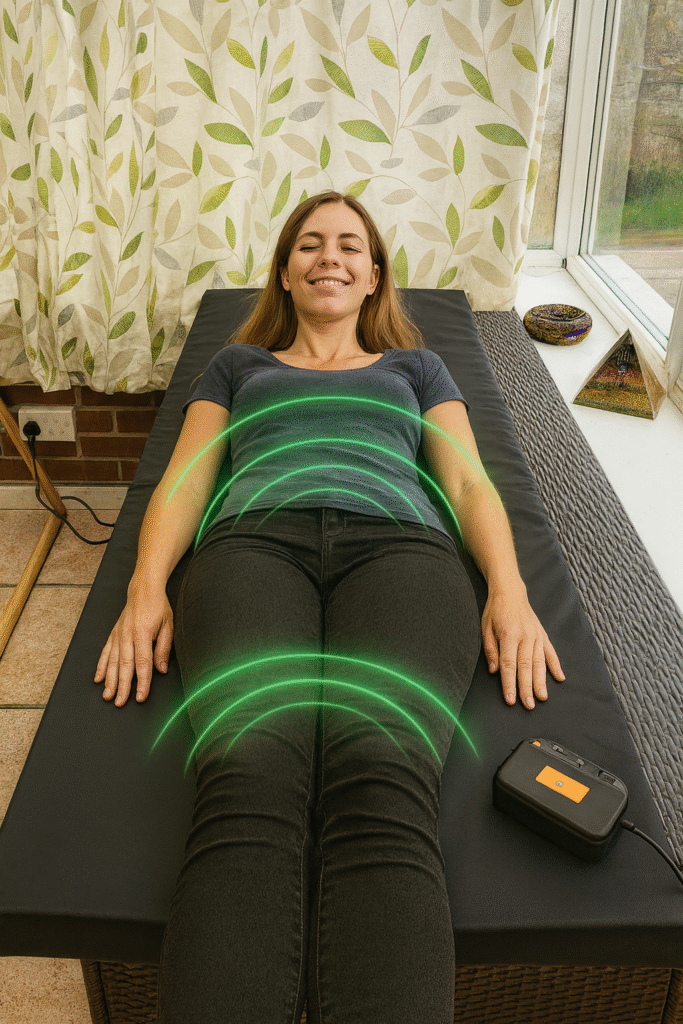
You may have seen cymatics videos where sand or water forms beautiful geometric patterns on a vibrating plate. That visual demonstration is inspiring, but “therapy” is usually more practical: it’s about how low-frequency vibration and sound can be delivered to the body—often through a pad, platform, chair, bed, or handheld device—so your tissues and nervous system can “feel” the rhythm.
In research settings, this is commonly studied under vibroacoustic therapy (VAT)—a noninvasive method where music or tones are combined with low-frequency vibration (often in ranges such as ~20–120 Hz, depending on the system and protocol). PMC+1
Why cymatic therapy might help chronic pain
Chronic pain is rarely “just in the body.” Over time, pain can become entangled with:
- nervous system over-protection (the body staying on high alert)
- tension patterns and guarding
- poor sleep and stress
- sensitisation (the system becoming more reactive)
Sound and vibration approaches are often explored because they may support pain indirectly by helping the body shift toward:
1) Nervous system calming (downshifting from fight/flight)
Many people feel chronic pain more intensely when stressed. Gentle vibration can be experienced as soothing and grounding—like a steady “signal of safety.”
2) Relaxation and muscle softening
When you feel safe, muscles often let go. When muscles let go, pain often becomes easier to manage.
3) Attention and sensory “re-patterning”
Rhythm and vibration can give the brain a new sensory input to focus on. For some people, this changes the felt experience of pain—even if the underlying condition remains.
These are not miracle claims. They’re realistic reasons why people explore cymatic therapy as a supportive tool.
What does the research say about vibroacoustic / sound-vibration therapy for pain?
Here’s the fairest summary: the evidence is promising in places, but mixed overall, and researchers repeatedly say better, larger trials are needed.
A scoping review of vibroacoustic therapy in adults with pain (2022)
A 2022 scoping review in BMJ Open mapped the research and concluded that studies vary widely in how they apply vibration (frequency, amplitude, pulsation, loudness), making it hard to compare results—while also calling for more rigorous randomized controlled trials. PMC
Music + low-frequency vibration and pain perception (2021)
A 2021 review discussing music combined with low-frequency vibration notes observed changes in pain perception and highlights how vibroacoustic therapy is being explored across conditions—again with variability in methods and outcomes. PMC
Fibromyalgia and low-frequency sound stimulation (2015)
Fibromyalgia is one of the most-studied chronic pain conditions in this area. A 2015 study investigated low-frequency sound stimulation in fibromyalgia, reflecting ongoing interest in sound-based approaches for chronic pain syndromes. PMC
Rhythmic vibroacoustic stimulation and fibromyalgia symptoms (2019)
A randomized controlled trial published in PLOS ONE reported preliminary evidence that rhythmic vibroacoustic stimulation may improve fibromyalgia symptoms and related issues—encouraging further investigation. PLOS
Chronic back pain pilot study (2018)
A pilot study looked at indirect vibroacoustic stimulation for chronic back pain using low-frequency sound waves applied through the hands and feet, exploring feasibility and potential symptom relief. Europe PMC+1
Ongoing clinical trials
ClinicalTrials.gov includes studies examining vibroacoustic sound waves for chronic back pain in controlled designs—useful because it shows the topic is active in clinical research. ClinicalTrials
Takeaway: The research doesn’t justify guaranteed outcomes—but it does support the idea that sound + vibration may be a useful, low-risk supportive approach for some people living with chronic pain, especially as part of a broader routine.
Cymatic therapy vs. PEMF for chronic pain: what’s the difference?
People often compare cymatic therapy with PEMF (Pulsed Electromagnetic Field) therapy, because both are “frequency-based” approaches—but they’re not the same.
- Cymatic / vibroacoustic therapy: primarily vibration + sound delivered mechanically/acoustically to tissues and the nervous system. PMC+1
- PEMF therapy: pulsed electromagnetic fields intended to influence cellular signalling, circulation, inflammation pathways, and recovery processes (depending on device and protocol). Pyramid Power Products+1
If you’re new to PEMF and want a clear foundation, these guides on Pyramid Power Products can help:
- “What Is PEMF?” Pyramid Power Products
- “What Is PEMF Therapy?” Pyramid Power Products
- “What Is a PEMF Device?” Pyramid Power Products
Why some people combine cymatics + PEMF for chronic pain support
When someone lives with chronic pain, they often need two things at once:
- A calmer nervous system
- Supportive physical input to the tissues
Cymatic therapy tends to shine for #1 (relaxation, soothing, rhythm, felt safety). PEMF is often chosen for #2 (cellular-level support and recovery-oriented routines). PMC+1
That’s why some people love a combined approach: vibration for regulation, PEMF for recovery support—while keeping expectations realistic and focusing on consistency rather than intensity.
Best practices: how to use cymatic therapy gently for chronic pain
If your goal is “support,” not “overwhelm,” this matters.
Start low and slow
- Begin with 5–10 minutes
- Use a comfortable level—never “push through”
- Do it once daily, then build gradually
Focus on consistency over intensity
Many wellness modalities work best as a gentle signal repeated over time.
Use it to support relaxation rituals
Try pairing cymatic sessions with:
- slow nasal breathing
- a warm drink afterward
- journaling or meditation
- a short walk
Pain often improves when the whole system feels safer.
Try common frequency ranges used in vibroacoustic contexts
Different systems use different ranges, but vibroacoustic therapy commonly explores low frequencies where vibration is strongly felt (often tens of Hz up to around 100+ Hz). PMC+2Europe PMC+2
You don’t need to chase a “magic number.” A calm, comfortable response is a better guide than hype.
Safety notes and contraindications
Cymatic / vibroacoustic approaches are generally considered noninvasive, but you should be sensible and cautious—especially with chronic pain conditions.
Be extra cautious and speak with a qualified clinician if you have:
- a pacemaker or implanted electronic device
- uncontrolled seizures
- pregnancy (especially around the abdomen/pelvis)
- recent surgery, acute inflammation, or fractures
- severe osteoporosis or fragile tissues
- conditions where vibration is contraindicated
And always stop if you feel worse, dizzy, nauseous, or overstimulated.
(As always: educational info only, not medical advice.)
Who tends to benefit most from cymatic therapy?
While everyone is different, cymatic therapy often appeals to people who:
- feel “wired and tired”
- carry tension and guarding patterns
- struggle with sleep and nervous system overload
- want a non-drug relaxation tool
- enjoy meditation, breathwork, or sound healing
It can be especially supportive when pain is tied up with stress, sensitisation, and poor rest—because it offers a direct experience of rhythm and soothing sensation.
Bringing it home: a gentle, modern way to support your healing journey
If you’ve been living with chronic pain, you deserve options that feel compassionate, not aggressive.
Cymatic therapy doesn’t have to be dramatic to be meaningful. Even a short daily session that helps you relax, breathe deeper, and soften your system can be a real step forward—because chronic pain often improves when your body stops feeling under threat.
And if you’re exploring frequency healing more broadly, pairing cymatics with PEMF can be a practical next step—especially if you prefer tools that feel grounded, noninvasive, and easy to integrate into daily life. (You can browse devices and guides via the Pyramid Power Products shop and learning posts.) Pyramid Power Products+1
Supporting evidence links you can cite in the article
Vibroacoustic therapy scoping review (BMJ Open / PMC)

Music + low-frequency vibrations and pain perception (PMC)

Low-frequency sound stimulation in fibromyalgia (PMC)

Rhythmic vibroacoustic stimulation for fibromyalgia symptoms (PLOS ONE)

Indirect vibroacoustic stimulation for chronic back pain (Europe PMC)

Clinical trial registry entry (ClinicalTrials.gov)